Learner

ISTE Standard 1: Educators continually improve their practice by learning from and with others and exploring proven and promising practices that leverage technology to improve student learning.
ISTE Standards for Educators
Educators utilizing the Learner standards will:
- Set professional learning goals to explore and apply pedagogical approaches made possible by technology and reflect on their effectiveness.
- Pursue professional interests by creating and actively participating in local and global learning networks.
- Stay current with research that supports improved student learning outcomes, including findings from the learning sciences.
Artifact #1: 2021-2022 Learning and Growth Goals (need to update design)
Planning ahead is always a great idea, so why not utilize my professional portfolio to demonstrate my forward-thinking and planning capabilities as an edTech professional? I will set two goals around the ISTE Standards for the next school year. The first goal will be a student-learning growth goal, required by the Oregon Department of Education (ODE). This goal will be centered on the ISTE Standards for Students and reads as follows:
Students will demonstrate continued growth towards mastery regarding the ISTE Digital Citizen and Creative Communicator standards throughout the 2021-2022 academic year. To measure this growth, I will utilize reflective strategies and tools centered on reflection. For example, I will use Likert Scales in Google Forms after students have encountered and utilized the identified standards to measure their reflective attitude regarding the standard in use.
The second goal I will set for next year will be a professional growth goal, also required by the ODE. This goal demonstrates my understanding of the ISTE Learner Standard, evidenced in its placement in this portfolio. The goal will read as follows:
I will read and review one edTech book* or deep dive and evaluate one emerging technology each month during the 2021-2022 academic year. I will post my reviews and evaluations on my edTech Blog.
*I will use this book list as a starting spot for edTech books.
Both of these goals represent meeting ISTE 1a because I am setting professional growth goals around pedagogy and technology while applying a reflective practice of both edTech literature and emerging technologies.
Artifact #2: COSN 2021
What’s a better way to network with fellow edTech professionals than attending a three-day, online, virtual conference? On March 2-4, I attended the 2021 Consortium for Schools Networking 2021 conference. COSN is a professional association for school educational technology leaders, and they provide resources, networking opportunities, and advocacy for their members. I experienced all of this as a non-member at this conference. I networked with fellow edTech educators in chatrooms, both message, and video. I also attended several seminars that pertained to my role within my district (Canvas Coach). The most notable presentation was one of the keynotes hosted by Weston Kieschnick, author of Bold School. In his presentation, Kieschnick provided educators a practical framework for evaluating and effectively integrating technologies into a school to support instruction versus the technology becoming the instruction.
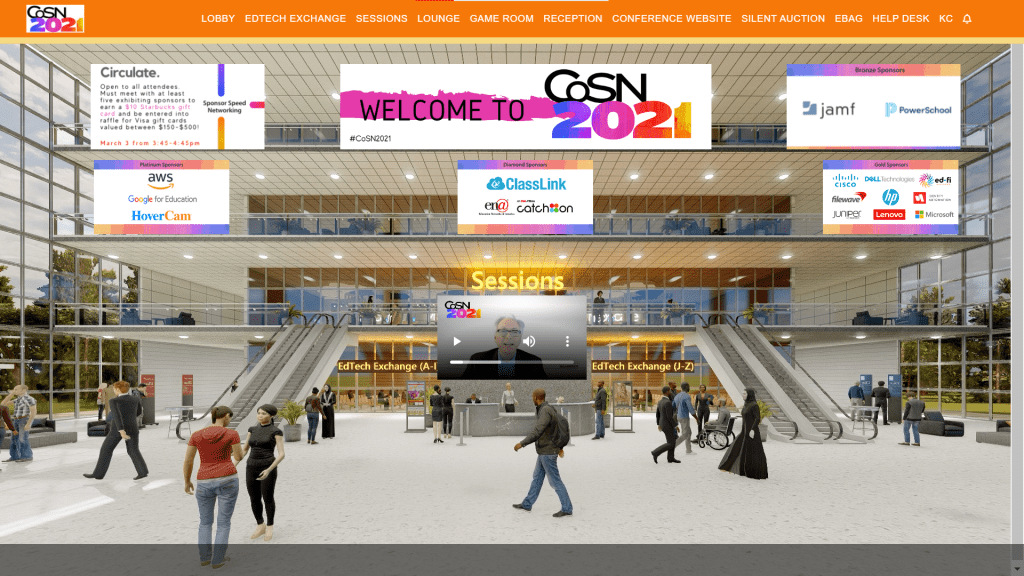
The COSN Conference reflects meeting ISTE 1b because I joined a new global network of edTech educators.
Contemporary Issues in edTech Artifacts
As edTech graduate students, we were asked to read copious amounts of edTech literature. If you visit my edTech Blog, you will find several responses and reactions to some of the more extensive publications we read in this course. From this literature, I tried to focus on topics I personally felt were the most pressing as we emerge from the pandemic and begin to evaluate all of the technology we allowed ourselves to use, personally and in education. In this evaluation, we, as educators, must consider the ethical implications regarding the increasing integration of digital technology in our lives, personally and professionally.
These essays reflect meeting ISTE 1c as they incorporate contemporary research on technological practices and how incorporating learning science research can increase student learning outcomes.
Emerging Technologies in edTech Artifacts
Educational Technology is a dual force discipline. Those in education know that a desire to learn is vital to being a successful educator, whether content, pedagogy, or student-related. The Technology side, which includes many disciplines, forces us to learn as digital and computer technology continues to evolve and develop at an increasing rate. Thus, Education Technology requires X2 the learning compared to either discipline. The following artifacts represent deep dives into two emerging technologies and how they affect education in the near future.
The respective deep dives represent researching emerging technologies in technology and how they can be utilized in education to enhance student learning outcomes, thus meeting ISTE 1c.
 KC Perley