Facilitator

ISTE Standard 6: Educators facilitate learning with technology to support student achievement of the ISTE Standards for Students.
ISTE Standards for Educators
Educators utilizing the Facilitating standards will:
- Foster a culture where students take ownership of their learning goals and outcomes in both independent and group settings.
- Manage the use of technology and student learning strategies in digital platforms, virtual environments, hands-on makerspaces or in the field.
- Create learning opportunities that challenge students to use a design process and computational thinking to innovate and solve problems.
- Model and nurture creativity and creative expression to communicate ideas, knowledge or connections.
Artifact #1: Theater Choice Menu
Once we were back in person, I knew I needed to provide students with a lot of flexibility and choice. This was true in all of my classes, but especially in theater. I had a diverse set of kiddos: different ages, grades, and experience, interest, and comfort levels. I chose to create a project choice board for student learning. As you can see, it turned out to be a menu.
The amazing thing about this menu was not its design or its variety. This menu bred independent and autonomous action by my students. Groups naturally formed as one would assume in a theater class, but the surprising thing was when non-theater students grouped up. Moreover, I missed a lot of school days during this quarter, but every time I returned to the classroom, the substitute letter would include the incredible facility my students had.
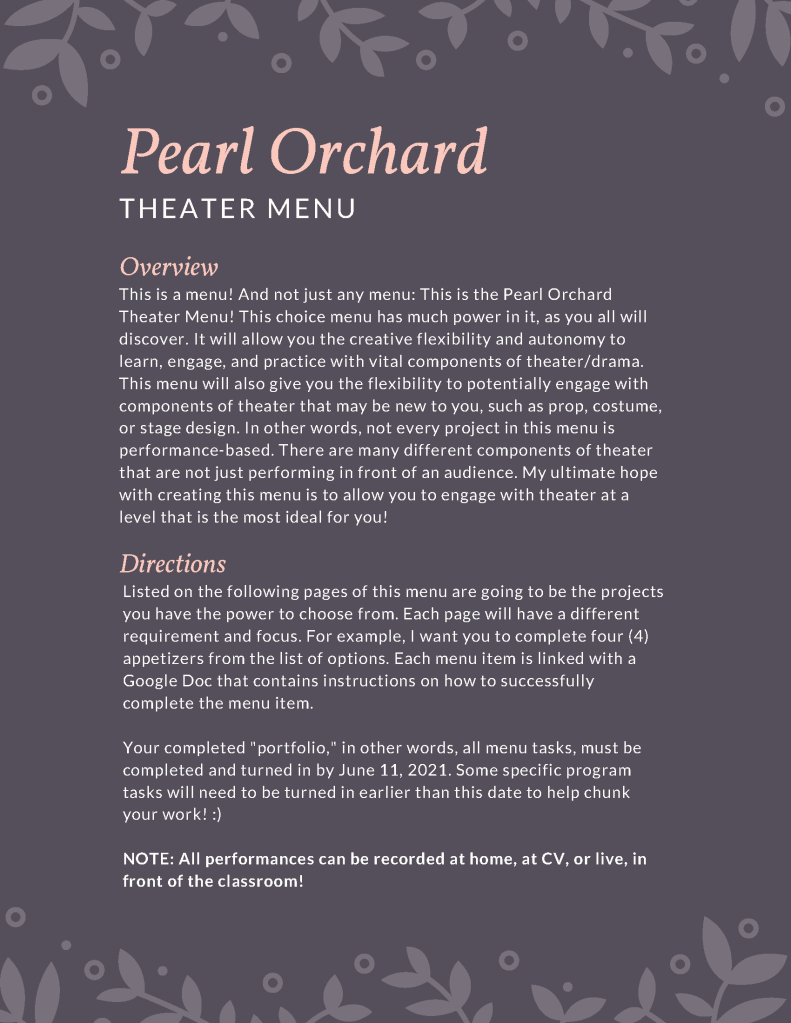
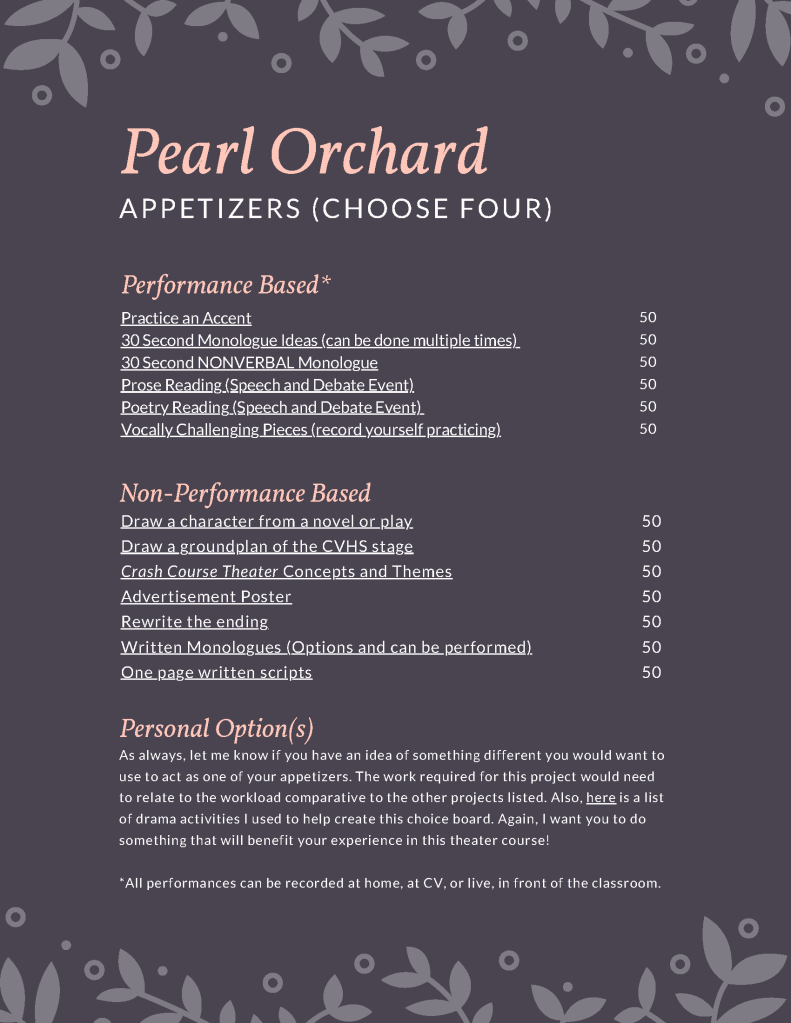
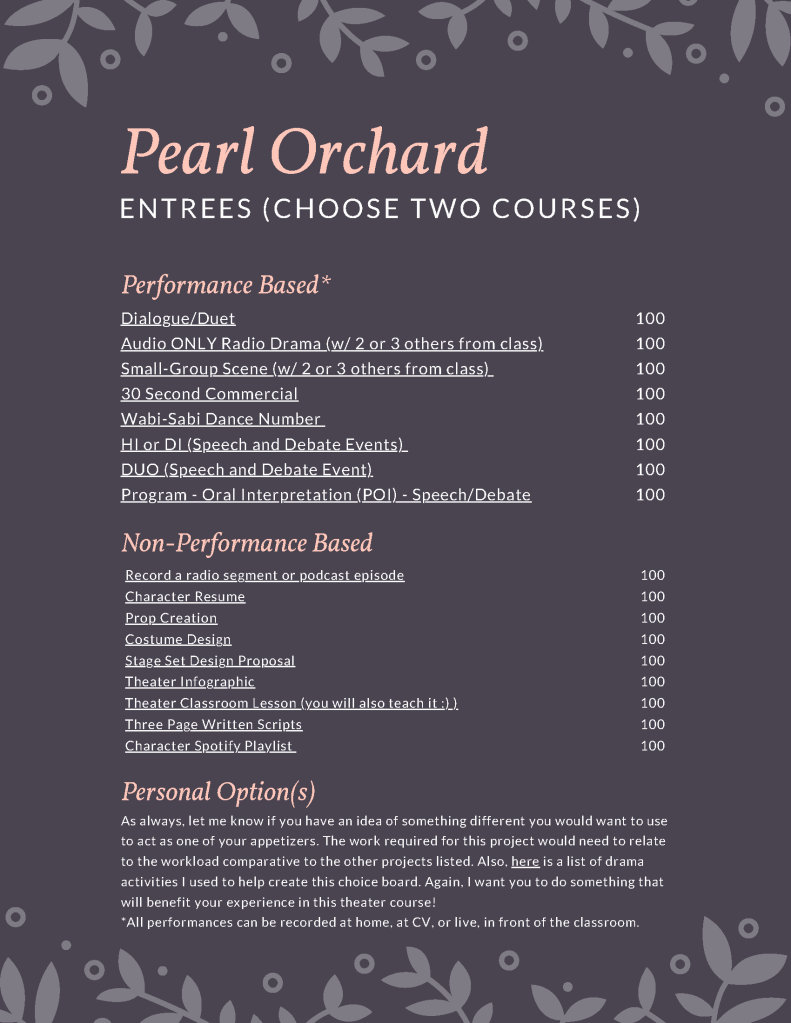
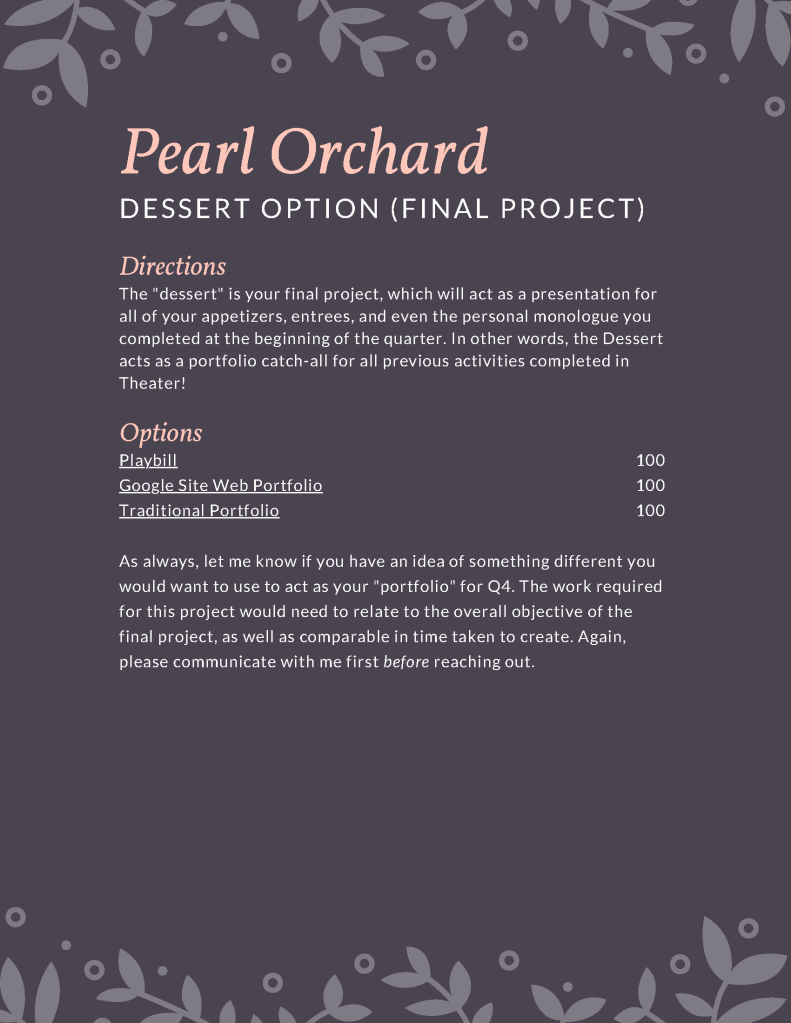
As mentioned above, students were fairly independent after receiving this project, both individually and in groups. Thus, this project menu represents satisfying ISTE 6a. It also represents ISTE 6b as the design and course leveraged the Canvas LMS, which ultimately, allowed students to use the screen recording functions to complete their work. The learning menu also meets ISTE 6d by providing students with a variety of options to incorporate creativity and creative expression.
Artifact #2: Canvas Course
Due to COVID-19, my school district needed to adjust the schedule to accommodate cohort sizes and social distancing. This resulted in AP courses occurring in the first semester of the school year, with the AP exams scheduled in May and June. Thus, I needed to figure out how to support my APUSH kiddos for four months.
So I created an APUSH Self-Study course in Canvas. The course was available for students to join and it bolstered what they should have learned during the first semester. The course includes review activities, review videos, multiple-choice quizzes, and essay practice discussions with peer reviewing. Although a lot of students did not utilize the course, I can attest that the students who did utilize this resource scored higher on their AP exams!
*Notice: This course was created within the Corvallis School District instance of Canvas and is ONLY for ePortfolio presentation. The course has NO enrolled students nor does it contain any form of personally identifiable information.
The creation of this course, along with its design, satisfies ISTE 6a and 6b. The course is designed for students to independently study for the AP US History exam by leveraging the Canvas LMS.
Artifact #3: PBL Example: Podcasting
Prior to the Western Oregon University edTech program, I was already professionally interested in integrating podcasting into the classroom. During the 2019-2020 school year, I incorporated podcasting into my US History and AP US History courses. Some students even published their mini-series online! Flash forward to the summer of 2020, I provided guidance for podcasting in the classroom as an example for project-based learning. This example was provided to secondary-level colleagues to encourage project-based learning to offset engagement concerns during distance learning.
This PBL podcasting guidance encourages colleagues and students to engage in the project-based learning design process. If implemented in STEM courses, my secondary colleagues could challenge students to use computational thinking in their projects. The challenge podcasting presents would be how to communicate computational thinking through the audio medium to engage the intended audience.
Please contact me directly if you would like a copy of this document.
The Canvas PBL example takes the PBL design process and combines it with podcasting. As mentioned above, if this PBL is utilized in STEM courses, it would require students to think of how to communicate computational thinking. Thus, this satisfies ISTE 6c. Podcasting also nurtures creativity and creative expression, thus meeting ISTE 6d.
Artifact #4: Podcast Episode!
In Podcast and Vodcasts, I honed my podcast creation skills that stemmed from the summer of 2020. To be candid, I love podcasts and having the opportunity to create multiple podcasts in a variety of courses throughout the WOU program was exciting. The most exciting part was learning new skills and technologies, such as audio recording and Audacity. Facepalm Facts is a podcast series that focuses on those fun facts and tidbits that make a person wish they washed their hands more regularly. Ultimately, this podcast episode represents my love for history, trivia, podcasting, learning, and teaching. There is also some creativity mixed in there as well.
FacePalm Facts: Clement Vallandigham
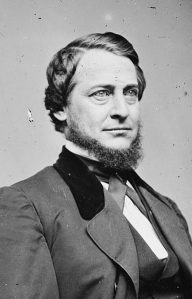
This podcast episode represents modeling a podcast episode, which satisfies ISTE 6d.
COVID-19 Distance Learning
The COVID-19 effectively turned all educators into online instructors. Personally, I started out by utilizing Google Classroom to support students through the end of the 2019-2020 school year. In June and July 2020, I taught several online courses for Umpqua Community College’s Upward Bound courses, leveraging the Canvas LMS. The most exciting course was Astronomy, in which I facilitated the use of Slooh’s online platform, which allows students to control telescopes to take images of objects in space. I was able to relate the course content at this time with the Neowise Comet, which was passing by during our course.
Then the 2020-2021 school year saw the CSD transitioning from Google Classroom to Canvas, and Google Meet to Zoom. I leveraged these technologies to facilitate engaging learning experiences in AP US History, US History, Theater, and AVID. The end of the school year saw the slow transition from online instruction to hybrid instruction.
Finally, the 2021 summer saw me back at Upward Bound, starting entirely online teaching math courses and then transitioning to a hybrid instructional model, using Canvas and Vernier technology to support in-person science courses that focused on collecting water quality data from the North Umpqua River.
Contact me if you would like to discuss my experience teaching online and hybrid during COVID-19.
Although a bold claim, I would argue COVID-19 distance and hybrid learning, represents all ISTE Facilitator substandards. The examples above show this as they were utilized with my students through the past year or so.
 KC Perley